
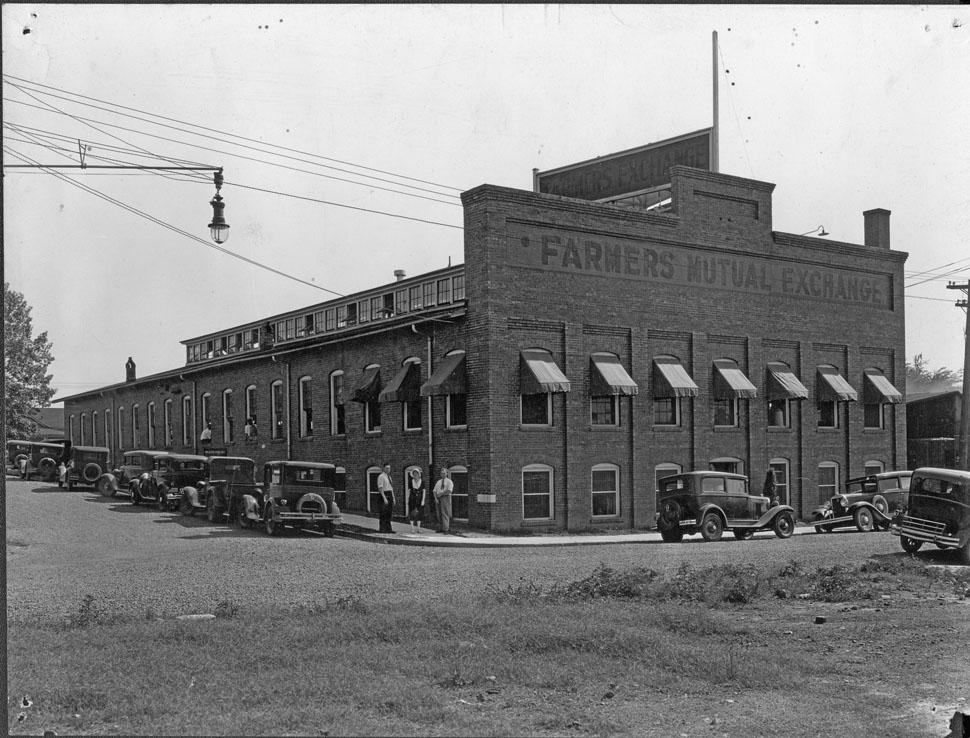
[Featured image: The Durham Farmers Exchange cooperative grew to 900 members, helping farm families make it through the Great Depression. Photo courtesy of the Durham County Library.]
Written by Tom Beckett
“Nothing will change until we change – until we throw off our dependence and act for ourselves.” – Myles Horton
Cooperatives: Putting in the Work
As Carolina Common Enterprise redesigns itself as a Nonprofit Worker Cooperative, we have to consider what it means to be a cooperative. While the Statement of Cooperative Identity is quite detailed, we can boil it down to a group’s mutual benefit from sharing and using three things:
- Shared labor – the work we put in to lighten our individual load.
- Shared expense – the money we put in to decrease our individual costs.
- Shared production – the things we make or grow ourselves to increase our individual return.
Cooperation aside, we know that labor and expense will always be required in our economic lives. There will always be expense in our economic lives, we will always have to work in some manner. The global economy now prefers that we do that in isolation, to extract as much as possible from each of us, and to keep us dependent on things that it controls.
The power of cooperatives comes from people putting their economic lives together. When we combine our purchasing choices, we have greater market power. When we work together, we have greater market power. Cooperatives give the people shared ownership and control over their own labor and resources for benefit that belongs to them, not to investors.
Here’s the rub: that benefit comes from working together – organizing, deliberating, deciding, planning, coordinating, and all the other elements of cooperation with other human beings – means putting in the work. Most of the time that requires putting in the work well before the benefit can be enjoyed.
Members of mature cooperatives may not need to put in much work. Systems of coordination and cash flow were created through the work of others in years past. But for a cooperative to thrive, the members still need to act as members and participate with their own time, attention, and labor.
- Be a patron – shop at your grocery co-op (instead of the chain), keep your money in your credit union and don’t go to a bank for a loan.
- Exercise everyday democracy – read the newsletters, bulletins, and other information from your co-op to know how well its business is doing.
- Serve on a committee or board – do the organizing, deliberating, planning, coordinating, and so forth that every organization needs to stay on track. This is not “volunteer” work; it is taking care of an enterprise we share ownership in.
- Go above and beyond – a cooperative may not ask much work of its members, but every contribution of time and effort a member contributes simply adds to the bounty for all the members and reduces the common expense.
Carolina Common Enterprise is experiencing very lean times right now. The financial and intellectual support we used to receive from USDA is gone. Our staff together decided not to give up and shut down under these circumstances. We believe that the work of building cooperatives and the cooperative movement is needed now more than ever. We have thrown off our old dependence and are building a new path. We are creating a new common enterprise together, with the understanding that revenue will have to come from different sources, and that the greatest benefit is still in the future.
Leave a Reply